
SELLING A HOME IN CALGARY How to Sell Successfully in 2026
Quick Answer
Calgary shifted into a more balanced market in 2025 — and that carried into 2026. Buyers have more listings to choose from, so they slow down, compare options, and negotiate more.
In 2026, results aren’t automatic. Homes still sell — but the ones that sell best are priced accurately, prepared properly, and launched with a clear plan. If a home feels overpriced, dated, or hard to love, buyers don’t rush in anymore — they move on.
Selling a home is about more than just price — it’s about preparation, presentation, marketing, timing, and negotiation. This guide explains what changed in Calgary’s market, why we moved into balance, where buyers have leverage, and how to sell with confidence in 2026.
On This Page
- What changed in 2025 (with key stats table)
- What a balanced market means
- Why Calgary moved into balance (supply + demand)
- The #1 mistake sellers make in a balanced market
- Property type deep dives (Detached, Semi, Townhome, Condo)
- The 2026 seller playbook (step-by-step)
- Seller FAQs for 2026
- Data + forecast disclaimer (sources)
What Changed in 2025
2025 was the year Calgary stopped feeling like a “multiple offers by default” market. Not because buyers disappeared — but because buyers finally had more choice.
- More listings: sellers faced more competition, even within the same neighbourhood.
- Less urgency: buyers no longer felt pressure to decide immediately.
- More comparison: buyers filtered by price, condition, layout, and value — and moved on quickly when something didn’t line up.
The table below shows the shift clearly. (On mobile, you can swipe left/right.)
← Swipe to view →
Source: CREB® statistics
What a Balanced Market Means
A balanced market means neither side has a big advantage. Buyers have enough options to be selective, and sellers can still succeed — but they can’t rely on urgency to do the job.
Key term: Months of supply (what it means)
Months of supply answers a simple question: If no new homes came on the market, how many months would it take to sell everything that’s currently listed at today’s pace?
- 1–3 months: Seller-favoured (limited choice, more urgency)
- 3–4 months: Balanced (buyers compare; sellers can still succeed)
- 5+ months: Buyer-favoured (more competition, more negotiation)
What Sellers Will See in a Balanced Market
In a balanced market, you will usually see:
- More showings before an offer happens
- More price sensitivity (buyers know what else is available)
- More conditional offers (inspection/financing becomes normal again)
- More importance on presentation (buyers eliminate homes fast)
- More negotiation on terms (possession dates, inclusions, repairs)
Balanced doesn’t mean slow. It means buyers can choose. Your home has to earn the offer by being priced and presented properly.
Why Calgary Moved Into a Balanced Market
Calgary moved into balance because supply increased while buyer demand returned closer to normal levels. That combination changed buyer behaviour in a very real way — especially how quickly buyers act and what they’re willing to pay.
1) New home supply increased (especially condos and higher-density homes)
New home construction surged through 2025, particularly in apartment-style and higher-density projects. By late 2025, there were over 26,000 new homes under construction across Calgary, with more than 17,700 of those being apartments.
New home starts are forecast to slow in 2026 (down roughly 34%), but completions still add inventory — and that matters most in the condo segment.
2) More resale listings came online
After several strong years, more homeowners chose to list in 2025. Calgary saw 40,000+ new resale listings, up from approximately 36,500 in 2024.
At the same time, total sales cooled to roughly 22,750 homes, down from about 27,000 the year before. That gap rebuilt inventory and gave buyers choice again.
3) Population growth and migration cooled from peak levels
Calgary continues to grow, but not at the extreme pace seen in prior years. Population growth is forecast at approximately 1.3% in 2026, down from around 3.0% in 2025.
For sellers, this doesn’t mean fewer buyers — it means fewer rushed buyers. When urgency drops, buyers take more time to compare and negotiate.
4) Mortgage rates changed buyer confidence (and patience)
Mortgage rates didn’t just affect affordability — they changed how buyers think. Buyers became more cautious, more analytical, and far less emotional than during the frenzy years.
Two important things sellers should know in 2026:
- The Bank of Canada overnight rate is forecast around 2.25% through 2026 (RBC Economics forecast shown in the CREB® outlook materials).
- Buyers shop monthly payment, not just price: they compare condo fees, property taxes, utilities, and even insurance more carefully than they did in 2021–2022.
In practical terms, buyers are quicker to eliminate homes that feel overpriced for what they offer. They don’t always negotiate first — they simply move on.
The bottom line: the market stopped doing the heavy lifting. In 2026, sellers who succeed understand buyer behaviour and price, prepare, and position their home with intention.
The #1 Mistake Sellers Make in a Balanced Market
Misunderstanding how buyers behave when they have choice.
Here’s what I want sellers to understand in 2026: most buyers don’t fall in love first and negotiate later. They screen online, compare options, and tour a shortlist.
When a home feels overpriced, dated, or risky, motivated buyers often don’t negotiate — they skip it. That’s how listings end up sitting longer, collecting price reductions, and creating the feeling that “something must be wrong.”
The real risk in a balanced market isn’t pricing too low. The real risk is positioning your home in a way that buyers ignore — and then chasing the market later.
Property Type Deep Dives (2026)
Calgary is not one market anymore. In 2026, your outcome depends heavily on property type, district, price range, and how your home compares to what buyers can choose today.
Detached Homes: How This Market Shift Affects Sellers in 2026
Detached homes remain the foundation of Calgary’s housing market — but 2025 marked a clear shift in how this segment behaves. While demand stayed relatively strong, higher uncertainty, slower migration, and increased competition from new homes pushed the detached market into more balanced conditions.
In short: detached homes are still selling — but buyers are far more selective, and outcomes vary widely by district, price range, and condition.
Detached Homes in 2025: The Key Numbers
- Total detached sales (2025): 11,328 homes (-8.7% year-over-year)
- New detached listings (2025): 19,621 homes (+13.8% year-over-year)
- Sales-to-new-listings ratio: 57.7%
- Average annual inventory: 2,521 homes (+56% year-over-year)
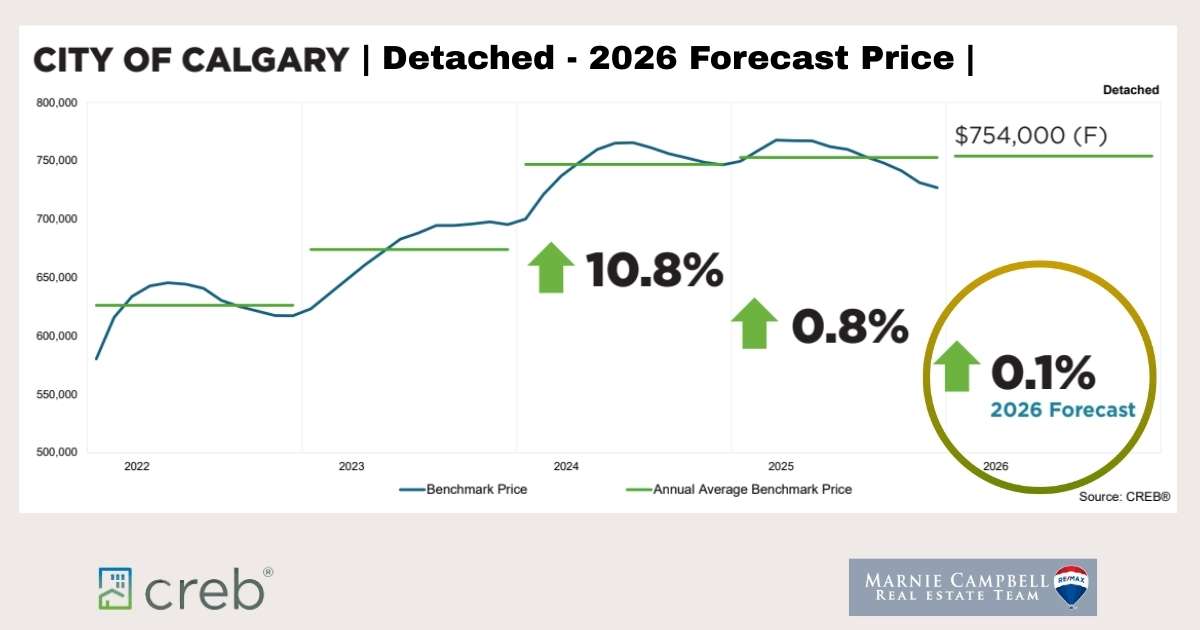
- City-wide benchmark price: ~$754,000
- Annual price change: +0.8% in 2025
This combination — fewer sales, more listings, and sharply higher inventory — is what moved detached homes out of seller-dominated territory and into balance.
What Detached Sellers Should Expect in 2026
2026 Detached Home Outlook:
- Price forecast: relatively stable, approximately -1% to +1% (CREB® outlook)
- Market conditions: balanced (not buyer-dominated or seller-dominated)
- Buyer behaviour: more comparisons, fewer emotional decisions
- Offers: conditional offers are normal again
Detached Home Prices by Calgary District (2025)
Detached home performance in 2025 varied significantly by district. This is why sellers need district-level pricing and expectations — not just a city-wide headline.
← Swipe to view →
| Calgary District | 2025 Detached Benchmark | YoY Price Change (2025) | What This Meant for Sellers |
|---|---|---|---|
| West | ~$970,000 | +3% | Strong demand and limited supply supported pricing |
| City Centre | ~$971,000 | +3% | Mixed results; condition and pricing discipline mattered most |
| North West | ~$791,000 | +1% | Steady, family-driven demand with balanced conditions |
| South | ~$728,800 | +1% | Balanced market with more price-sensitive buyers |
| South East | ~$716,000 | +1% | Stable demand, but competitive resale environment |
| North | ~$672,500 | 0% | More competition from newer homes in some pockets |
| North East | ~$600,500 | -2% | Most price pressure due to elevated supply |
| East | ~$513,500 | -2% | Buyers held more leverage; pricing accuracy was critical |
Source: CREB® 2026 Forecast (district benchmark references)
Months of Supply: Why Price Range Matters for Detached Sellers
Detached homes don’t behave the same at every price point. In 2026, the higher you go, the more careful buyers get — and the more your pricing and presentation need to feel justified.
← Swipe to view →
| Detached Price Range (City-wide) | Months of Supply (Approx.) | Seller takeaway |
|---|---|---|
| $500,000–$599,999 | ~2.4 months | Still relatively tight; good homes can move quickly |
| $600,000–$699,999 | ~2.4 months | Balanced — pricing discipline matters |
| $700,000–$799,999 | ~2.8 months | More comparison; condition and layout show up in negotiations |
| $800,000–$899,999 | ~3.0 months | Balanced-to-buyer-leaning; the best listing wins the bracket |
| $1M+ | ~3.2 months | More buyer leverage; presentation and price justification are everything |
Note: This is a simplified city-wide snapshot to explain the pattern. Your exact bracket can differ by district.
What This Means for Detached Sellers in 2026
Here’s the honest reality for detached sellers in 2026: buyers are still active, but they are selective by default. The days of buyers stretching or overlooking issues just to “get in” are behind us.
- Buyers start with strict price filters: if your list price feels even slightly out of step, many buyers won’t book a showing.
- Condition is under a microscope: deferred maintenance, aging systems, and dated finishes matter more when buyers can compare.
- Price needs clear justification: lot size, upgrades, layout, location, or livability must clearly support the ask.
- Buyers move on quickly: if a home doesn’t make sense early, most buyers don’t come back later.
What hasn’t changed: well-positioned detached homes still sell.
How Detached Sellers Win in 2026
- Price precisely: use the most recent solds and understand your active competition (because buyers will).
- Prepare early: buyers notice deferred maintenance immediately.
- Show value clearly: layout, lot, upgrades, and livability matter more than ever.
- Launch with intent: the first 10–14 days still carry the most leverage.
Bottom line for detached sellers:
Detached homes remain Calgary’s most stable segment, but success in 2026 comes from understanding buyer behaviour in a choice-rich market — and positioning your home accordingly from day one.
Semi-Detached Homes: What This Market Shift Means for Sellers in 2026
Semi-detached homes are a smaller slice of Calgary’s resale market, but they’re a really important one — especially for move-up buyers and inner-city lifestyle buyers.
In 2025, semi-detached stayed resilient on price, even while the market overall cooled. The big shift for 2026 is that buyers are comparing more carefully. They’re asking: “Does this semi feel worth it for the price?”
Semi-Detached Homes in 2025: The Key Numbers
- Total semi-detached sales (2025): 2,159 homes (-8.28% year-over-year)
- New semi-detached listings (2025): 3,636 homes (+15.94% year-over-year)
- Sales-to-new-listings ratio (2025): 59.44%
- Average annual inventory (2025): 488 homes (+70.37% year-over-year)
- Annual benchmark price change (2025): +2.5%
Benchmark Price: Where Semi-Detached Is Headed in 2026
2026 Semi-Detached Outlook (City of Calgary):
- 2026 forecast benchmark price: $691,200
- 2026 forecast forecast change: +0.8% (essentially stable)

What This Means for Semi-Detached Sellers in 2026
Semi-detached homes sit in a very specific decision space for buyers in 2026. They’re often chosen as a step up from a townhome — or as a more affordable alternative to a detached home — which means buyers think carefully about what they’re getting for the money.
- The price gap matters: buyers notice when you’re priced close to entry-level detached homes.
- Layout and light matter more: awkward floorplans or dark interiors are harder to overlook when there are options.
- Condition is decisive: buyers expect a semi to feel move-in ready, not like a compromise.
- Location carries weight: walkability, schools, parks, and commute convenience often tip the decision.
How Semi-Detached Sellers Win in 2026
- Price with discipline: anchor to the most recent solds and adjust based on your active competition (what buyers can buy today).
- Make value feel obvious: light, layout, finishes, and how the home looks online matter more than almost any marketing claim.
- Remove friction: pre-list maintenance, clean presentation, and clear inclusions reduce buyer hesitation.
- Launch like you mean it: the first 10–14 days still matter most — that’s when serious buyers decide.
Bottom line for semi-detached sellers:
Semi-detached homes can still sell very well in 2026, but the homes that do best are the ones that feel priced correctly, cared for, and easy to say yes to.
Row & Townhomes: How This Market Shift Affects Sellers in 2026
Row homes (including townhomes) felt the market shift earlier and more clearly than most segments in 2025. Sales slowed, inventory climbed, and buyers became noticeably more selective — especially as new construction and resale options increased across the city.
Row Homes in 2025: The Key Numbers
- Total row home sales (2025): 3,838 homes (-17.41% year-over-year)
- New row home listings (2025): 6,729 homes (+10.29% year-over-year)
- Sales-to-new-listings ratio: 57.0% (-25.12% year-over-year)
- Average annual inventory: 947 homes (+87.44% year-over-year)
- City-wide benchmark price change (2025): -2.1%
- 2026 forecast change: -1.9% (CREB® outlook)

What This Means for Row Home Sellers in 2026
Row homes are expected to remain under mild pricing pressure overall, with conditions improving only gradually as new construction slows. Buyers are payment-focused and comparison-driven in this segment — so small differences (fees, condition, updates, parking, layout) can change the outcome.
Apartment Condos: What This Market Shift Means for Sellers in 2026
Apartment-style condos saw one of the clearest shifts in 2025. When supply rises and buyers have choice, condos become a much more “comparison market” — buyers weigh building vs building, fees vs fees, and value vs value.
Apartment Condos in 2025: The Key Numbers
- Total apartment sales (2025): 5,427 (-28.28% year-over-year)
- New apartment listings (2025): 10,730 (-0.92% year-over-year)
- Sales-to-new-listings ratio: 50.6% (-27.62% year-over-year)
- Average annual inventory: 1,786 (+51.38% year-over-year)
- Annual benchmark price change (2025): -2.7%
- 2026 forecast change: -3.5% (CREB® outlook)
- 2026 forecast benchmark price (City of Calgary): $310,000 (F)

Apartment Benchmark Prices by Calgary District (2025)
Condos are extremely district- and building-specific. Use this as a starting point, then zoom in to your building, your unit type, and your true competition.
← Swipe to view →
| Calgary District | 2025 Apartment Benchmark | YoY Price Change (Band) | Seller takeaway |
|---|---|---|---|
| West | $347,542 | Varies by building (CREB® map banding) | Premium pockets can hold value better, but buyers still compare hard |
| City Centre | $328,542 | Varies by building (CREB® map banding) | Most inventory sits here; pricing + fees + condition decide outcomes |
| North | $329,683 | Varies by building (CREB® map banding) | Value-driven buyers; turnkey units show best |
| North West | $309,575 | Varies by building (CREB® map banding) | Comparisons are tight; layout + parking + fees matter |
| South | $301,317 | Varies by building (CREB® map banding) | Balanced-to-buyer-leaning; buyers want low friction |
| South East | $343,125 | Varies by building (CREB® map banding) | Good demand in strong pockets, but new supply can change the feel fast |
| North East | $291,475 | Varies by building (CREB® map banding) | More price pressure; the best-priced listing tends to win |
| East | $246,325 | Varies by building (CREB® map banding) | Most affordability-focused; condition and fees are deal-makers or breakers |
Source: CREB® 2026 Forecast (district benchmark references; condo outcomes vary significantly by building and fee structure)
Months of Supply: Apartment Condos by Price Range (City-wide snapshot)
This is one of the clearest ways to explain condo behaviour: as price rises, buyers become more selective and months of supply tends to increase.
← Swipe to view →
| Apartment Price Range | Months of Supply (City-wide) | What sellers should expect |
|---|---|---|
| <$300,000 | ~3.6 | Balanced; price + fees decide the shortlist |
| $300,000–$399,999 | ~4.0 | Balanced-to-buyer-leaning; buyers compare hard |
| $400,000–$499,999 | ~4.2 | More negotiation; condition and building reputation matter more |
| $500,000–$599,999 | ~4.7 | Buyer leverage increases; uniqueness needs to be clear |
Source: CREB® 2026 Forecast (apartment months-of-supply table excerpt; simplified here as a city-wide snapshot)
How Condo Sellers Win in 2026
- Price with proof: not just past sales — your current competition in the building matters.
- Make the monthly cost feel reasonable: buyers look at condo fees, taxes, and utilities as part of value.
- Reduce uncertainty: clean documents, clear inclusions, and strong showing condition remove hesitation.
- Win online first: photos, light, floorplan flow, and staging matter more when buyers scroll fast.
The 2026 Seller Playbook (How to Sell Successfully)
If you remember one thing from this page, let it be this: in 2026, you don’t win by hoping. You win by planning.
Step 1: Start with a pricing range (not a guess)
- Use recent solds (last 30–60 days), not last spring.
- Compare to active competition (what buyers can choose today).
- Adjust for condition, upgrades, layout, street, and lot.
Step 2: Prepare for buyer standards (not seller hopes)
- Fix obvious defects (buyers have options, so they avoid risk).
- Declutter and brighten (buyers eliminate homes fast).
- Improve first impressions (front entry, paint touch-ups, lighting).
Step 3: Launch like it matters (because it does)
The first 10–14 days are still the most important window. That’s when your listing is new, buyers pay attention, and you get the highest-quality feedback.
- Strong photos + clear descriptions
- Floor plan (where possible) and quality online presentation
- Marketing that reaches buyers beyond just MLS exposure
Step 4: Negotiate for price and certainty
- Conditions are normal again (inspection/financing).
- Terms matter: possession, inclusions, deposits, condition length.
- The best deal is the one that closes with the least stress.
Step 5: Respond quickly to market feedback
If showings are low, something is off (usually price or presentation). If showings are strong but offers are missing, the home may not feel like the best option in its bracket. In 2026, smart sellers adjust early — before the listing goes stale.
Want to know what this means for your home?
Book a short NO-OBLIGATION call and we’ll walk through pricing, preparation, and timing — clearly and honestly.
Schedule a CallCalgary Home Selling FAQs (2026)
Is 2026 a good year to sell a home in Calgary?
Yes — but 2026 is a strategy year. Homes still sell, but results aren’t automatic. The listings that do best are priced accurately, prepared properly, and launched with a clear plan. If your home feels overpriced or “hard to love,” buyers don’t wait around — they move on.
What changed in Calgary’s market compared to the 2021–2022 frenzy?
Buyer behaviour. In 2021–2022, urgency did a lot of the work. In 2026, buyers have more choice, so they compare carefully, ask more questions, and negotiate more confidently. That doesn’t mean you can’t sell — it means your home has to earn the offer.
Should I price high “to leave room to negotiate”?
In a choice-rich market, pricing high often reduces showings. Most buyers don’t negotiate first — they filter and eliminate. If your home doesn’t compete well in its price range, it gets skipped. Then you risk price reductions later, and buyers negotiate harder because the listing feels stale. Accurate pricing protects your leverage early.
How do you determine the right listing price for my Calgary home?
We don’t rely on automated estimates. We price based on recent solds (last 30–60 days), your current competition, market pace (months of supply), and how buyers behave in your specific price bracket. We also adjust for condition, upgrades, lot, layout, street, and how the home will show online — because perception affects offers.
What should I fix (or not fix) before listing in 2026?
In 2026, buyers avoid risk — because they have options. We recommend fixing the items that trigger hesitation fast: peeling paint, broken fixtures, lighting issues, obvious wear, leaks, and anything that suggests deferred maintenance. You don’t need to renovate everything — you need to remove the “question marks” that make buyers slow down or negotiate harder.
Why do the first 10–14 days matter so much?
That early window is when your listing is new, alerts go out, and serious buyers are actively comparing. If you launch with the right price and strong presentation, you create momentum. If you miss the mark, it’s hard to recreate that same level of attention later — and the market starts negotiating with you.
Are conditional offers normal again in 2026?
Yes — in many cases, conditions are normal again (financing and inspection). That’s not a bad thing. It simply means buyers are taking a more careful approach. The goal is to negotiate not just price, but certainty — strong deposits, clean condition dates, and terms that protect you.
What’s the biggest mistake sellers make in a balanced market?
Assuming buyers will “come around.” In 2026, if a home feels overpriced, dated, or risky, many buyers don’t negotiate — they move on to the next option. The biggest mistake is letting a listing sit too long and then chasing the market with reductions. The strongest strategy is to position your home correctly from day one.
How do I get started with a smart 2026 selling plan?
Start with a short, no-pressure conversation. We’ll review your timeline, what matters most (price vs speed vs certainty), and the current market in your neighbourhood — then outline exactly how we’d price, prepare, and launch your home. Schedule a no-obligation call and we’ll take it from there.
Helpful Next Reads & Seller Resources
- Sell a Home in Calgary – your full seller authority hub
- Find Your Calgary Home Value – start with a no-obligation evaluation
- Pricing Strategy – how to price to attract strong buyers
- Home Staging – preparation that increases buyer perceived value
- Home Marketing – photos, video, and listing storytelling
- Digital Campaigns – targeted exposure beyond MLS
Final thought: In 2026, selling well is still very possible — but it’s more intentional. When pricing, preparation, and marketing line up, buyers respond.
— Marnie

Marnie is a trusted Calgary REALTOR® with 19+ years of experience, over 800 real estate transactions, and 150+ five-star reviews. She leads a team dedicated to helping clients make confident, no-regret real estate decisions.
Learn more about Marnie →
Read our Google Reviews →
Market Data & Forecast Disclaimer (Sources)
The information and insights on this page are based on a combination of historical market data, published forecasts, and professional interpretation. While every effort has been made to ensure accuracy, real estate markets are influenced by many factors and can change.
Data sources referenced include, but are not limited to:
- Calgary Real Estate Board (CREB®) MLS® sales, pricing, and inventory statistics
- CREB® 2026 Forecast: Calgary & Region Yearly Outlook Report
- RBC Economics interest rate and economic outlooks
- Bank of Canada policy rate guidance
Forecasts and projections are not guarantees of future performance. Individual property outcomes may vary based on location, property type, condition, pricing strategy, and broader economic conditions. This content is intended for general informational purposes only and does not replace personalized real estate advice.